The real reason Bitcoin adoption failed in El Salvador
El Salvador made businesses accept Bitcoin and gave citizens $30 in BTC to download its wallet, yet in 2024 only 8.1% paid with it. What Pix shows instead.

El Salvador made every business accept Bitcoin, yet most people don't use it to pay. In 2021 it became the first country to make Bitcoin legal tender, and the government gave $30 in bitcoin to every citizen who downloaded its state wallet, Chivo. Most people who downloaded it used it once to collect the $30, and stopped. In 2024 only 8.1% of people used Bitcoin to pay for anything, and in 2025, as part of a deal with the IMF, accepting it became optional. In my opinion the reason is simple, you just can't force freedom on people.
What El Salvador actually did
On 7 September 2021 El Salvador became the first country in the world to make Bitcoin legal tender, through what they called the Bitcoin Law.
The law said every business had to accept bitcoin as a way to pay, for every transaction.
To get people in, the government set up a US$150 million trust and launched its own wallet app, Chivo. Every citizen who downloaded it got $30 in bitcoin, not in dollars, which was worth about 3.75 days of minimum wage there.
But no person was ever forced to use it, the $30 was there so people would download it.
Most people took the $30 and stopped
By December 2021, a survey from the public opinion institute of UCA, a university in El Salvador, found that 56.6% of the people they asked had downloaded Chivo.
Of the people who downloaded it, 55.1% used it only once, to collect the $30 the government gave them.
Only 4.2% used it every day, and 6.7% downloaded it and never used it at all.
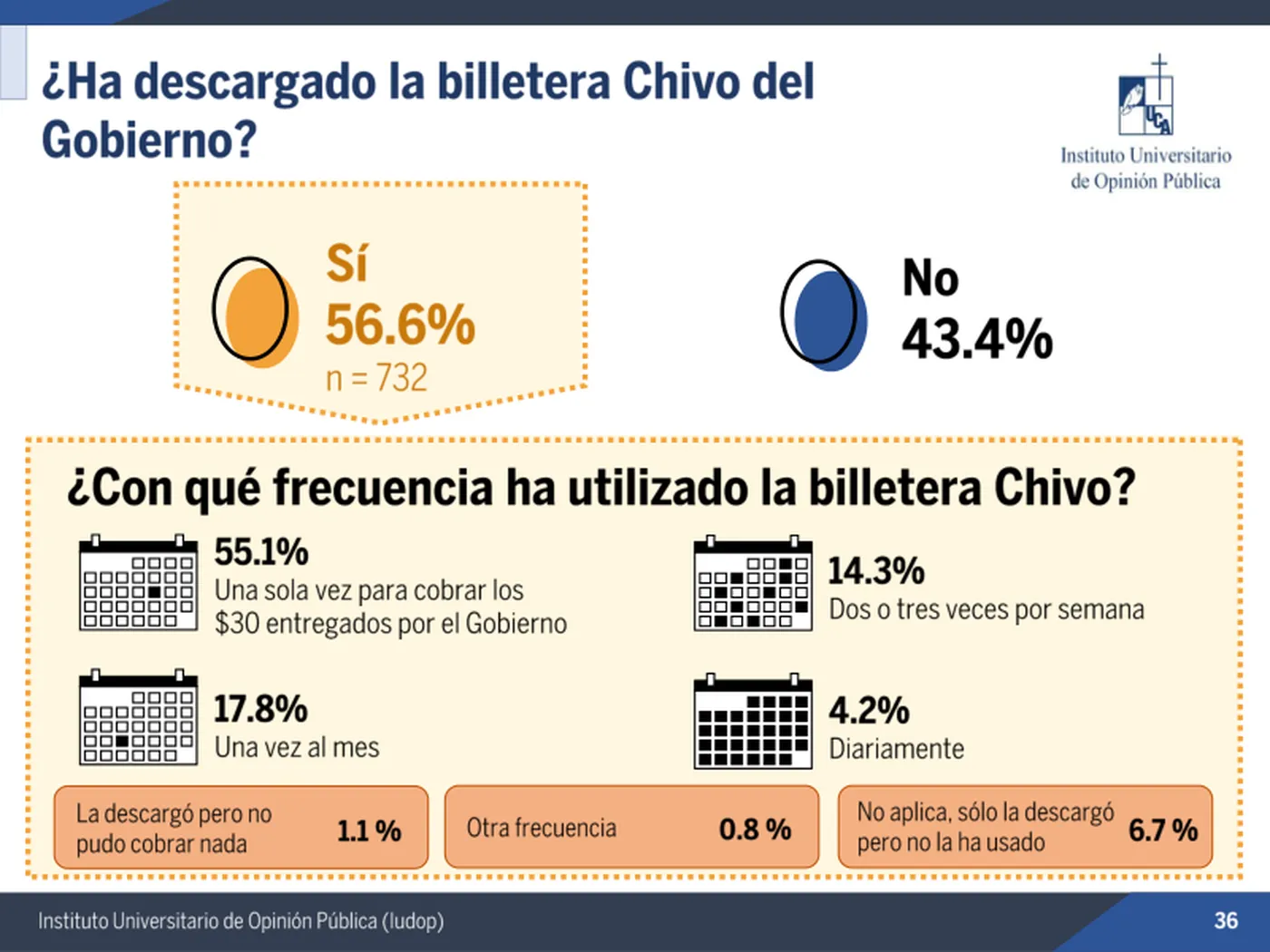
Source: UCA IUDOP, year-end 2021 survey, slide 36
A study published by the US National Bureau of Economic Research found the same thing from another angle, only 20% of all the people they surveyed kept using Chivo after spending the bonus.
You might think people just needed more time to get used to it.
Yet it went the other way. In 2021, 25.7% of people used Bitcoin to pay for something. By 2024 it was 8.1%, the lowest year since the law, so about 92 in every 100 people didn't use it to pay at all that year.
Even for remittances, the money families receive from relatives living abroad, crypto wallets carried only 0.7% of the roughly US$3.3 billion sent between January and April 2026, according to the central bank figures reported by the BBC.
Optional, and part of the IMF deal
In January 2025 El Salvador's Legislative Assembly changed the law with Decree 199. Bitcoin is still called legal tender there, but accepting it is now voluntary, for people and for businesses.
A month later, on 26 February 2025, the IMF approved a 40 month loan of about US$1.4 billion. Making Bitcoin acceptance voluntary for the private sector was one of the reforms in that deal, together with tax payments being made only in US dollars.
The headline you see at the start of my video says $3.5 billion. That is the size of the whole financing package as CoinDesk reported it, the IMF loan itself is about $1.4 billion.
The state wallet changed hands too. On 1 October 2026 the IMF confirmed that majority ownership and control of Chivo had been transferred to a private operator, and the BBC reported the state stays on as a shareholder.
So, it failed
At least the adoption did, and that is the part I'm talking about.
The reserve is a different story. As of 8 October 2026 the government still held 7,798.37 BTC, worth around US$636 million at the time, a number that moves with the price.
A former head of the country's central bank, quoted by the BBC, said that if you look at the reasons the president gave for adopting Bitcoin, there is no doubt the project failed, and also that at least no money has been lost.
The IMF's October 2026 review says some of the deal's conditions on Bitcoin accumulation were not met and were waived, and that no further accumulation is planned beyond documented donations.
In Brazil nobody forced Pix on us
I'm Brazilian, so the comparison that comes to my mind is Pix, the instant payment system created by Brazil's central bank.
Nobody forced it on us, most of us use it because it's easier.
The big banks were forced though. Every bank and payment company with more than 500,000 active customer accounts had to offer Pix, but using it was always our choice.
By the end of September 2026, 168 million people in Brazil were registered on Pix, plus almost 19 million businesses, according to the central bank's own data.

Bitcoin wins the same way
Bitcoin wins when it's the easier choice, not the law.
One of Bitcoin's best-known advocates, quoted by the BBC, said something very close, that they don't think Bitcoin needs a decree forcing people to use it, and that its adoption will happen naturally.
Would you get paid in Bitcoin if your country made you?
Keep reading
References
NBER Working Paper 29968 on Bitcoin as legal tender in El Salvador (April 2022, revised February 2023), source for El Salvador becoming the first country to make bitcoin legal tender on 7 September 2021, every business having to accept bitcoin, the $30 bonus for citizens who downloaded Chivo worth 3.75 daily minimum wages, and 20% still using Chivo after the bonus: nber.org
UCA IUDOP year-end 2021 survey, slide 36 (fieldwork 7 to 17 December 2021, 1,298 interviews), source for 56.6% downloaded, 55.1% used it once to collect the $30, 4.2% daily, 6.7% never used it: uca.edu.sv
elsalvador.com, 16 January 2025, reporting the UCA IUDOP survey of 5 to 17 December 2024 (1,266 interviews), source for 25.7% in 2021 and 8.1% in 2024: elsalvador.com
BBC News Mundo, 12 October 2026, source for the US$150 million trust, the 7,798.37 BTC (about US$636 million on 8 October 2026), the 0.7% of US$3.286 billion in remittances (January to April 2026), the state staying as a Chivo shareholder, and the quotes from the former central bank head and the Bitcoin advocate: bbc.com
Decreto Legislativo No. 199, Asamblea Legislativa de El Salvador, 29 January 2025, source for voluntary acceptance while Bitcoin keeps its legal tender status, and for the 2021 Bitcoin Law (Decree 57 of 8 June 2021): asamblea.gob.sv
IMF Press Release 25/043, 26 February 2025, source for the 40 month loan of about US$1.4 billion, voluntary Bitcoin acceptance and taxes paid only in US dollars: imf.org
IMF Press Release 26/316, 1 October 2026, source for Chivo moving to a private operator, the waived Bitcoin accumulation conditions and no further accumulation beyond documented donations: imf.org
CoinDesk, 19 December 2024, source for the $3.5 billion package headline and the $1.4 billion IMF share: coindesk.com
Banco Central do Brasil, Voto 217/2020 (Resolução BCB nº 1, 12 August 2020), source for Pix being set up by the central bank and being mandatory for institutions with more than 500,000 active accounts: normativos.bcb.gov.br
Banco Central do Brasil, Pix open data (registered users, 30 September 2026), source for 168,245,596 people and 18,729,138 businesses registered: olinda.bcb.gov.br