The Bitcoin Company Dream Is Falling
MSCI is removing Strategy from its indexes on November 30, and public companies almost stopped buying bitcoin. What that tells us about where crypto goes next.

Last week MSCI, the company behind some of the biggest stock indexes in the world, confirmed it is removing Strategy from its indexes at the close of November 30. Metaplanet, the Japanese company that followed the same playbook, was cut from its Japan small cap index too.
If you were around crypto last year, you know why this matters.
We all felt it. Companies buying bitcoin at a scale we had never seen, every week a new announcement, a new company changing its name, a new "bitcoin treasury" listed somewhere. It moved the market a lot, and it felt like the start of a new trend, where every company, old or new, would hold a piece of bitcoin.
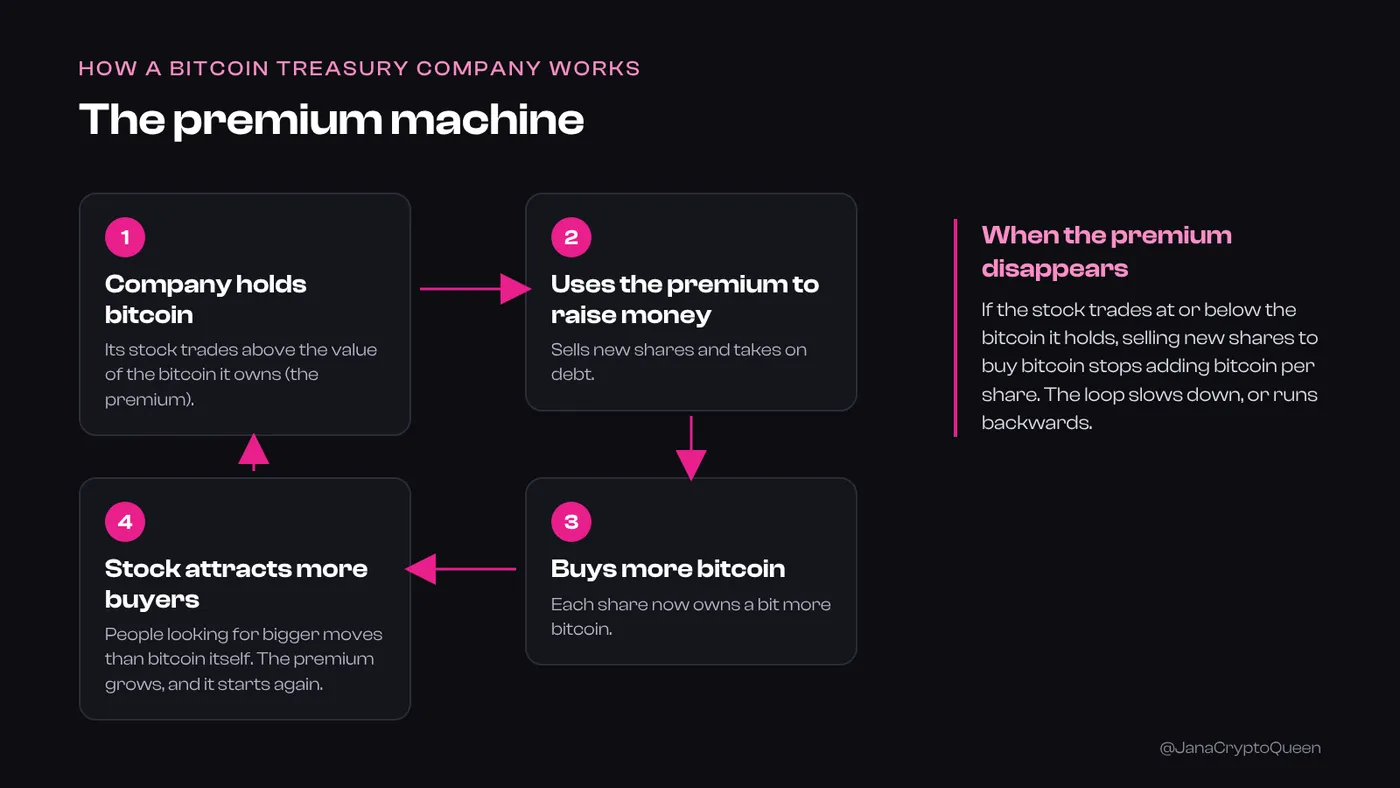
The idea was simple. A listed company holds bitcoin, its stock trades above the value of the bitcoin it owns, it uses that premium (plus debt) to raise more money, buys more bitcoin, and the stock attracts even more people looking for big movements. Bitcoin with leverage, wrapped in a stock anyone can buy.
Yet that thesis is failing right now.
What happened with MSCI and Strategy?
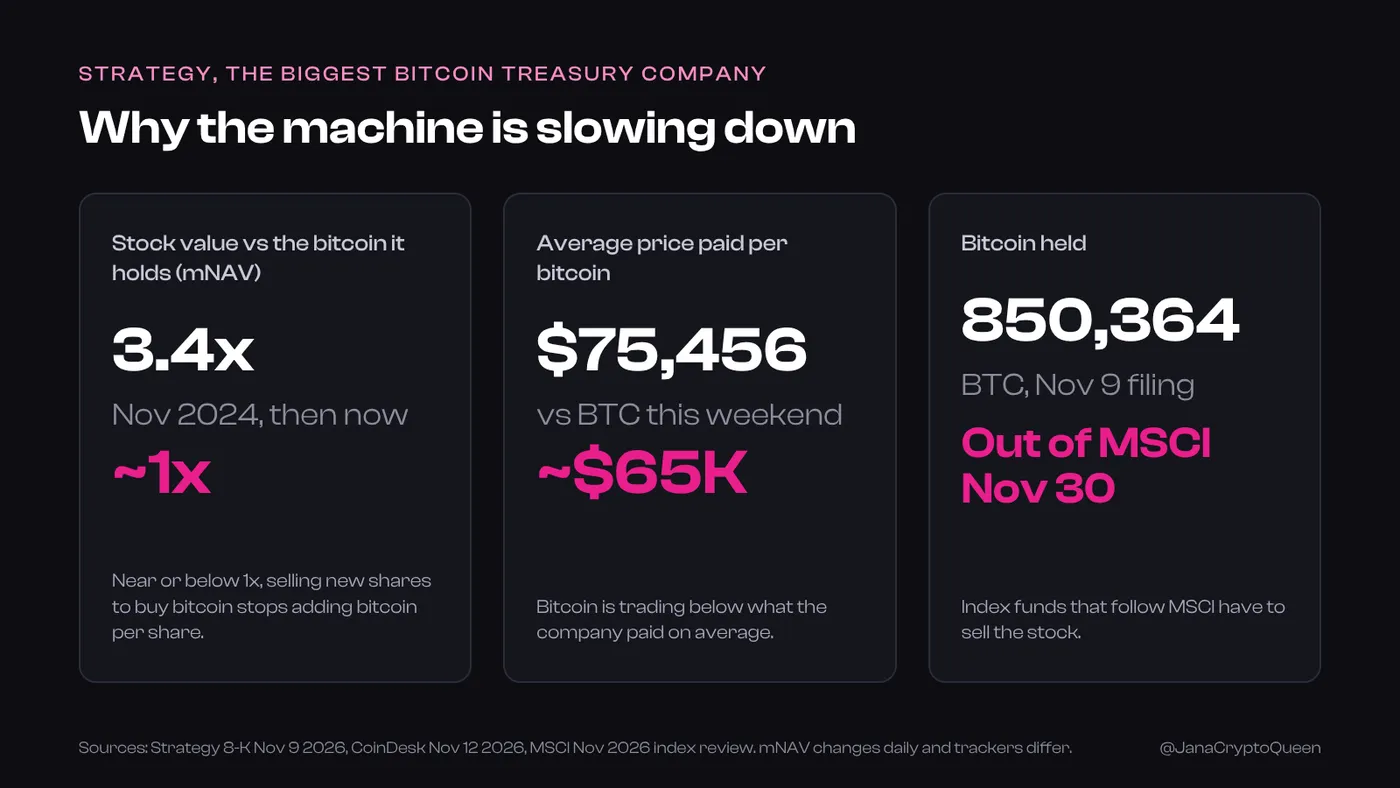
In October MSCI adopted a new rule for what it calls "non-operating companies", businesses where most of the balance sheet is assets sitting there instead of an operating business. Strategy holds 850,364 bitcoin (from its own filing on November 9), so it didn't pass the screen.
Funds that follow those indexes now have to sell. Strategy says those funds hold about 13 million of its shares (around 3.1%). Older estimates of the forced selling go up to $2.8 billion, but that number was made on an earlier version of the rule, so I take it as a rough idea, not a fact.
Why the premium matters
That whole machine only works while the stock trades above the value of the bitcoin the company holds. At its peak in November 2024, Strategy traded at about 3.4 times its bitcoin. Last week it was around 1x, and some trackers already show it below that. Below 1, every new share sold to buy bitcoin means each share owns less bitcoin, not more.
And bitcoin is now trading under what Strategy paid on average (about $75,456 per coin according to its filing, against roughly $65K this weekend).
Is it just one company?
You might think this is a Strategy problem. It isn't.
Corporate buying almost stopped. In Q2 this year, public companies added about 129,600 BTC combined. In Q3 it was about 7,300 (a drop of roughly 94%). Twelve companies that started a bitcoin treasury in 2025 sold their entire position, mostly to pay debt or give money back to shareholders. Miners are selling too, one of the biggest just sold 13,597 BTC (about $1.1 billion) to pay loans and move into AI data centers.
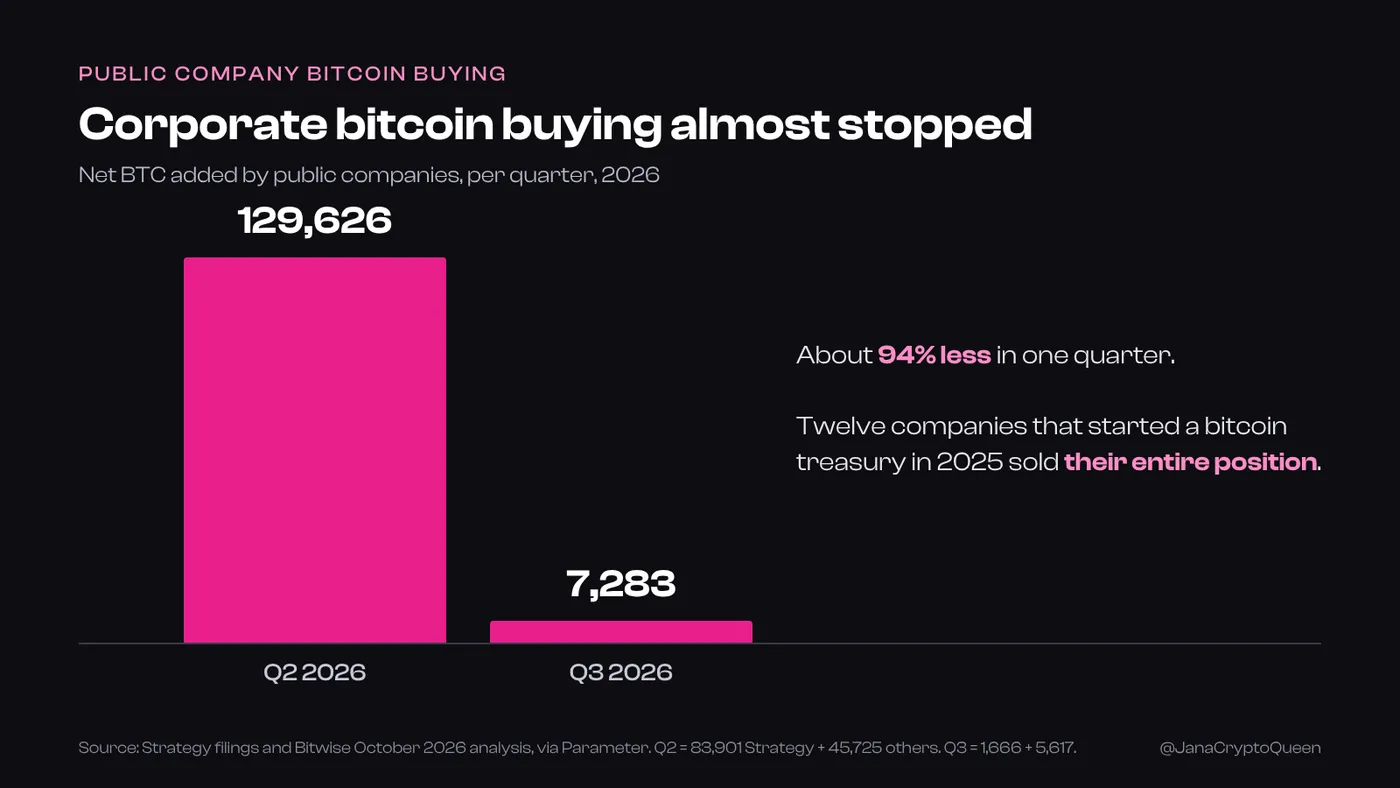
So the trend we were all excited about, every company holding bitcoin, is going the other way. More listed companies are deciding they don't want this on their books, and an index provider just decided it doesn't want them in its indexes. That tells us something about how traditional markets still see bitcoin.
Why did the bitcoin treasury model fail?
I keep asking myself this. Maybe the market just didn't prove itself enough. Maybe it all happened at the wrong time, companies raising money to buy near the top, then inflation coming back hotter and a December rate hike back on the table, money getting more expensive right when this model needed it cheap. I don't know, and I don't think anyone really knows yet.
Some analysts think the index exit is already priced in and won't touch bitcoin itself, and they might be right.
What I do see is that a lot of the excitement was never about bitcoin itself. It was about leverage on bitcoin. A stock that moved faster than the coin. And we saw in the last few weeks how fast that works the other way.
What the US midterms change for crypto
For the last year a lot of people said the US was becoming the home for crypto. A friendly administration, a stablecoin law signed in July 2025, a big market structure bill (the CLARITY Act) that passed the House.
Yet the picture changed on November 3. The opposition party won both the House and the Senate in the midterms, and the new Congress starts on January 3, 2027. The CLARITY Act already failed a key Senate vote in September (49 to 50, it needed 60), and bills that don't pass before a Congress ends usually have to start again from zero. The President also can't run for a third term, the Constitution only allows two, so this friendly era had an end date either way.
Whatever side you are on, the lesson for crypto is the same. A thesis that depends on one government, one party or one person is fragile.
The stablecoin law still takes effect on January 18, 2027, so not everything goes away. But maybe we were too quick to call any one country the home of crypto. The global economy is shifting again, like it already has so many times, and maybe a bigger reset is coming. I'm not sure.
What this means for bitcoin holders
I'm not saying bitcoin failed. I'm saying the wrappers around it are being tested, the companies, the indexes, the politics.
Owning a company that owns bitcoin is not the same as owning bitcoin. Holding it through a fund or an exchange is not the same as holding it yourself. Every layer between you and the asset is a layer someone else controls, a board, an index committee, a Congress, a market that decides your premium is gone.
I came into Web3 because I was tired of systems where a few people decide for everyone. Weeks like this remind me why, and I want to remind myself as much as anyone reading this.
So I want to hear from you.
Do you think the bitcoin company trend is over, or did it just happen at the wrong time?
Keep reading
References
MSCI, November 2026 Index Review announcement (effective close of Nov 30)
Cointelegraph, MSCI confirms Strategy, Metaplanet index removals
CoinDesk, MSCI exclusion could hit Strategy's bitcoin buying machine (mNAV, 3.4x peak, holdings)
Bitcoin Magazine, Strategy adds 1,036 BTC (850,364 total, $75,456 average cost, Nov 9 8-K)
CryptoTicker, MSCI drops Strategy from MSCI World on November 30
KuCoin, CLARITY Act and the midterms (vote history, GENIUS Act dates)