
Before crypto, I was an actual mining engineer. Iron ore, gold, copper — things you can touch, weigh, and ship across oceans on massive cargo ships. So when the crypto world started talking about Real-World Assets, I had a very different reaction than most people in this space. ⛏️
I didn't see hype. I saw the inevitable.
🏗️ So What Actually Is an RWA?
Real-World Asset (RWA) tokenization means putting ownership of physical or traditional financial assets on a blockchain. A digital token represents a real thing.
Think about it this way:
🏠 Real estate — own a fraction of a building in New York for $100
🥇 Gold & commodities — tokenized gold, oil, agricultural products
🏦 US Treasuries — government bonds earning yield, on-chain
📈 Private credit — lending backed by real-world collateral
✈️ Aviation assets — own a piece of a jet engine (ETHZilla launched this in 2026)
💰 Why This Is a Multi-Trillion Dollar Opportunity
Let's talk scale. Traditional assets sitting in the physical world:
Global real estate: $330 trillion
Global bond market: $130 trillion
Global equities: $100+ trillion
Total crypto market cap: ~$3 trillion
RWA is the bridge. And we're just at the beginning. 🤯
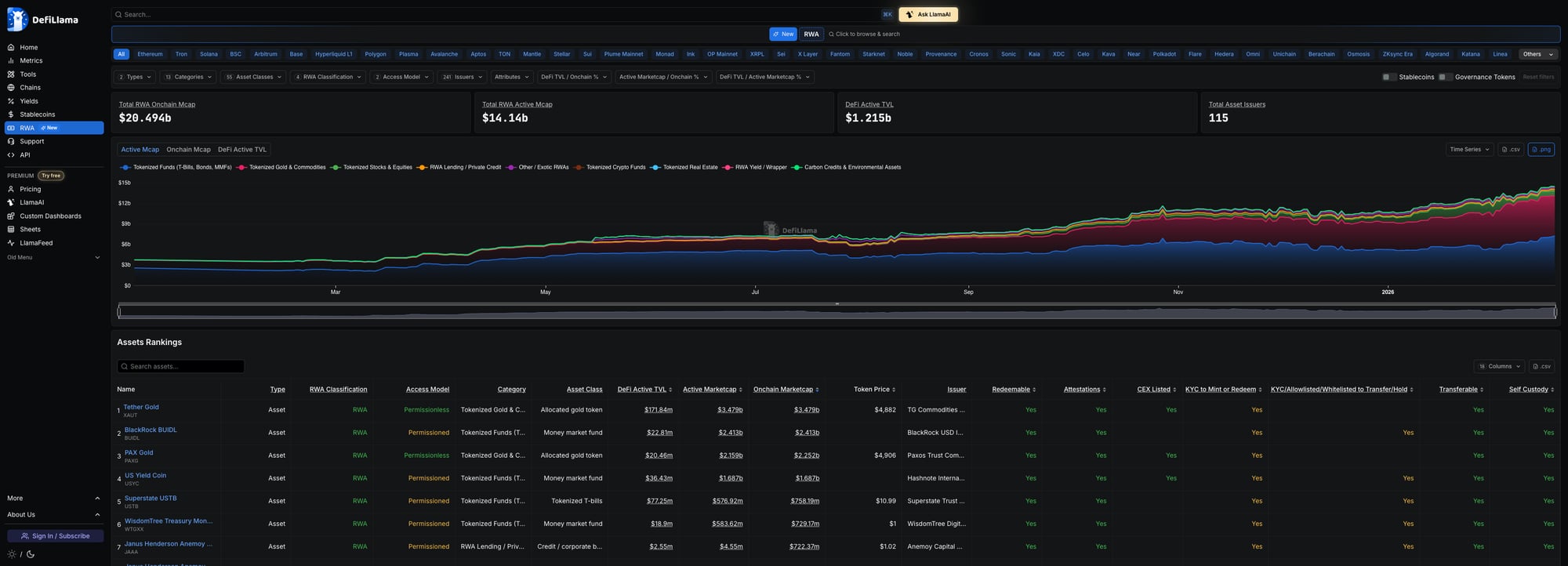
Source: DeFiLlama — defillama.com/rwa
📊 The Numbers Don't Lie
When I posted my thread in May 2025, RWA TVL had just hit $12.3B. Today it's crossed $20B. The growth speaks for itself:
$20.5 billion total RWA market cap onchain as of February 2026
115 asset issuers — from BlackRock to DeFi-native protocols
Tokenized equities grew nearly 3,000% in 2025 alone
BlackRock BUIDL tokenized fund: $2.4B onchain
New regulations in the U.S., U.K., and Hong Kong are accelerating adoption
BlackRock's COO Rob Goldstein called digital ledgers "the most exciting development in finance since double-entry bookkeeping 700 years ago." That's not hype — that's conviction. 👀
🔑 Who's Building This?
Ondo Finance — tokenized US Treasuries + building on-chain prime brokerage
Maple Finance — institutional private credit on-chain
Centrifuge — real-world lending pools (invoices, real estate, etc.)
BlackRock BUIDL — the legacy finance giant going fully on-chain
Securitize — tokenized equities, leading with new SEC rules
⛏️ Why I Actually Care About This
When I worked in mining, fractional ownership of physical assets was impossible for regular people. The paperwork, the lawyers, the minimum investment — all designed to keep normal investors out.
Now imagine a small investor in Brazil owning a fraction of a gold mine, a US Treasury bond, or a property — all from their phone. No bank. No broker. No middleman.
That's not just crypto. That's financial inclusion at scale. 🇧🇷💙
🚀 Where This Is Headed
Institutions are already here. Retail is next. Once UX simplifies and regulations clear, we'll see:
Tokenized private equity for everyday investors
24/7 trading of traditionally illiquid assets
DeFi composability — use tokenized real estate as collateral for a loan
Emerging markets leapfrogging traditional finance entirely
RWA isn't just a narrative. It's crypto's upgrade from speculative asset to the foundation of global finance. 💎
👑 Bottom Line
We're at the start of a multi-decade shift. The bridge between the $700+ trillion traditional finance world and crypto is being built right now.
I've seen the physical side of these assets. I've held them. Now I'm watching them go on-chain. And I'm here for all of it. 🙌
Want to follow the RWA space with me? Join Queen's Lounge 👇 t.me/QueensLounge
📚 References
DeFiLlama RWA Dashboard — https://defillama.com/rwa
Jana's original RWA thread (May 2025) — https://x.com/JanaCryptoQueen/status/1924929734086926338
Tokenized equities explode 3,000% in 2025 — https://www.coindesk.com/business/2026/01/30/the-market-for-tokenized-equities-has-exploded-by-almost-3-000-in-a-single-year
Institutions fuel tokenized RWA boom — https://www.coindesk.com/markets/2026/02/11/institutions-fuel-tokenized-rwa-boom-as-retail-looks-set-to-follow-suit
ETHZilla real estate tokenization $4.7M — https://www.coindesk.com/business/2026/02/04/ether-treasury-firm-pushes-deeper-into-tokenization-acquiring-usd4-7-million-in-home-loans